Data Centre Industry and the Role of Valves in Cooling Systems
Data Centre Cooling Methods & Sustainability: A Complete Guide (and the Critical Role of Valves)
As global data demand accelerates and AI workloads grow more power‑hungry, data centres face increasing pressure to cool more efficiently, reduce energy use, and operate more sustainably. Cooling is one of the largest contributors to a facility’s energy footprint — often accounting for 30–40% of total power consumption — meaning the choice of data centre cooling methods directly influences efficiency, operating costs, and carbon impact.
This guide provides a comprehensive overview of the main data centre cooling systems, their pros and cons, sustainability implications, and how industrial valves help optimise performance across every cooling architecture.
Why Cooling Strategy Drives Data Centre Sustainability

Cooling efficiency affects several critical sustainability metrics, including:
- Energy consumption & PUE
- Water usage
- Carbon footprint
- Refrigerant management
- Heat‑recovery feasibility
- System resilience & uptime
Even small improvements in cooling performance can deliver significant sustainability gains due to cooling’s large share of overall energy use.
Overview of the Main Data Centre Cooling Methods

Below is a simplified, high‑level comparison:
| Cooling Method | Efficiency | Ideal Use Case | Sustainability Impact |
|---|---|---|---|
| CRAC | Moderate | Small or legacy facilities | Lower – uses DX refrigeration |
| CRAH | High | Large / hyperscale | High – integrates well with economisers & free cooling |
| Direct‑to‑Chip Liquid Cooling | Very high | AI / HPC workloads | Very high – enables heat reuse and reduces mechanical cooling |
1. Air‑Based Cooling Systems
1.1 CRAC Units (Computer Room Air Conditioning)
CRAC units use direct expansion refrigeration to cool air in IT spaces.
Pros:
- Widely used and familiar to operators
- Straightforward maintenance
Cons:
- Less energy‑efficient than modern alternatives
- Higher operating costs at scale
- Limited suitability for high‑density racks
Sustainability rating: Moderate — CRAC is generally less efficient for larger or high‑density environments.
1.2 CRAH Units (Computer Room Air Handling)
CRAH units use chilled water coils to condition and circulate air.
Pros:
- More energy‑efficient than CRAC
- Integrates well with free cooling
- Ideal for hyperscale facilities
Cons:
- Requires chilled‑water infrastructure
Sustainability rating: High — efficiency improves further when paired with economisers.
Recommended BM Valve Products:
- Butterfly valves for isolation and modulation
- Globe valves for accurate chilled‑water throttling
2. Liquid Cooling Systems
Liquid cooling solutions have become essential for AI, GPU clustering, and extreme‑density compute environments.
2.1 Direct‑to‑Chip (Cold‑Plate) Cooling
Coolant is circulated through cold plates mounted directly onto processors.
Benefits:
- Removes heat at the source
- Requires less air movement
- Compatible with heat‑recovery loops
- Supports higher densities with lower energy overhead
Recommended BM Valve Products:
- Ball valves for tight shut‑off and control in coolant loops
- Check valves to prevent backflow into pumps and chillers
How Valves Enable Efficient, Sustainable Cooling
Valves are at the heart of every cooling system — air‑based or liquid‑based. They regulate chilled‑water flow, coolant pressure, and distribution through racks, coils, heat exchangers, and redundant cooling loops.
Valves provide essential functions such as:
- Flow control across chilled‑water circuits
- Pressure stability in CRAH/CRAC systems
- Balancing and isolation across piping networks
- Efficient heat transfer through controlled flow rates
- Fail‑safe protection via pressure‑relief valves
In data centre cooling towers, chillers, CRAH units, backup generators, and fire‑suppression systems, valve precision directly influences uptime and efficiency.
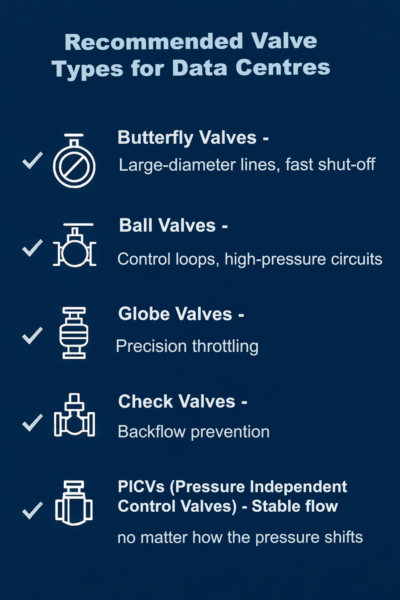

Recommended Valve Types for Data Centres
(With links to BM Engineering’s supply pages)
✔ Butterfly Valves — Large‑diameter lines, fast shut‑off
https://bmeng.v-ex.dev/butterfly-valves/
✔ Ball Valves — Control loops, high‑pressure circuits
https://bmeng.v-ex.dev/category/products/valves/ball-valves/
✔ Globe Valves — Precision throttling
https://bmeng.v-ex.dev/product-category/valves/
✔ Check Valves — Backflow prevention
https://bmeng.v-ex.dev/product-category/valves/
✔ PICVs (Pressure Independent Control Valves) — Stable flow regardless of pressure changes
(BM data centre industry overview)
https://bmeng.v-ex.dev/industry/data-centre/
Stay Connected
Connect With BM Engineering Supplies
LinkedIn: https://www.linkedin.com/company/bm-engineering-supplies
YouTube: https://www.youtube.com/channel/UC3546s0-sAomKMkm3QNJCVw
Facebook: https://www.facebook.com/BMEngineeringSuppliesLtd/photos/
FAQs
Why is cooling strategy important for the sustainability of data centers?
Cooling strategy influences key sustainability metrics such as energy consumption, water usage, carbon footprint, refrigerant management, heat recovery potential, and system resilience, making efficient cooling crucial for reducing environmental impact.
What are the main types of data center cooling methods covered in this guide?
The guide covers air-based cooling systems like CRAC and CRAH, liquid cooling solutions including direct-to-chip cooling, and describes their efficiency, use cases, and sustainability impact.
What are the advantages and disadvantages of CRAC units?
CRAC units are widely used and easy to maintain, but they are less energy-efficient and more costly at scale, especially unsuitable for high-density racks.
How do liquid cooling solutions enhance data center performance?
Liquid cooling, such as direct-to-chip cooling, removes heat at the source, supports higher densities with lower energy use, and enables heat reuse and system efficiency.
What role do valves play in optimizing data center cooling systems?
Valves regulate flow, maintain pressure stability, facilitate heat transfer, and provide fail-safe protection, making their precise control essential for efficient and reliable cooling.