


What Is Filtration? How Filtration Works in Industrial Applications
What Is Filtration? How Filtration Works in Industrial Applications
Filtration is essential across modern industry, and many engineers and plant managers still seek a clear explanation of what filtration is and how it works in real‑world applications. Understanding these fundamentals helps ensure processes run efficiently, safely, and in compliance with strict quality standards. From removing solids to protecting equipment and enhancing product consistency, filtration supports operations across food and beverage, pharmaceutical, chemical and manufacturing sectors.
This article explains filtration in an accessible, top‑of‑funnel format while linking directly to BM Engineering’s filtration solutions to support buyers at the early research stage.
What Is Filtration in Industrial Processing?
Filtration is the process of removing unwanted particles, solids or contaminants from a liquid or gas by passing it through a barrier known as a filter medium. Industrial filtration helps improve product quality, protect critical equipment (such as pumps, flowmeters and valves), reduce downtime, and maintain hygiene and compliance standards.
BM Engineering supplies a wide range of filtration and ancillary equipment—such as Y‑strainers, duplex strainers and pipeline filters—used in food, beverage, water, and hygienic processing environments.
How Does Filtration Work Across Different Applications?
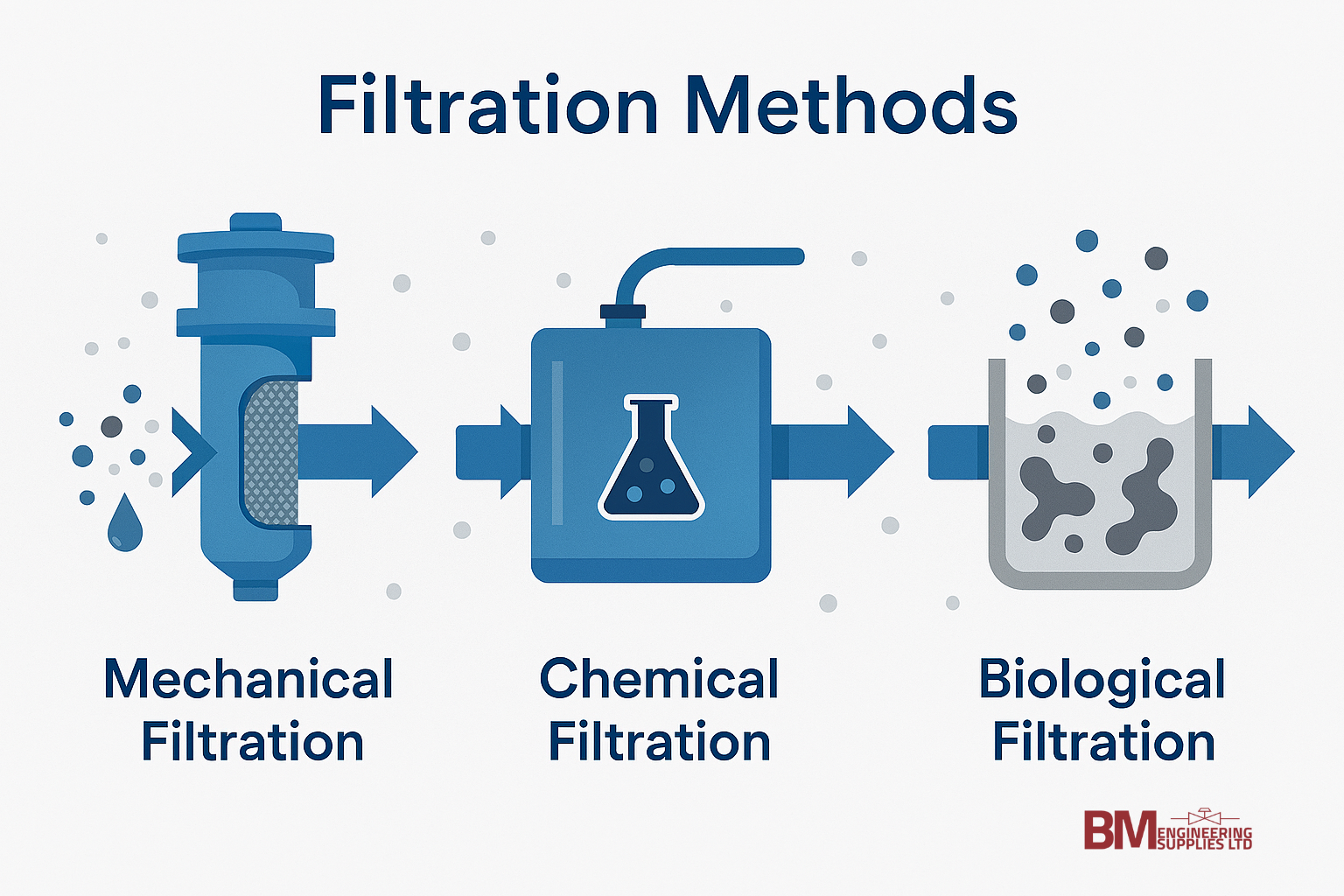
Different filtration methods work in different ways depending on the type of contaminants and the required level of purity. To understand how filtration works, it helps to break down the three main mechanisms.
Mechanical Filtration Explained
Mechanical filtration physically traps particles using a mesh, perforated screen or cartridge. This is the most common form of filtration and is used anywhere particulate removal is needed.
BM Engineering guides on selecting mechanical filtration solutions such as Y‑strainers, Simplex basket strainers, and Duplex basket strainers.
What are pipeline strainers and filters?
Chemical Filtration Explained
Chemical filtration uses adsorption, ion exchange or catalytic conversion to remove dissolved contaminants. Activated carbon filters and catalytic media are typical in food, beverage, pharmaceutical and water treatment applications.
Biological Filtration Explained
Used primarily in wastewater treatment, biological filtration relies on microorganisms forming a biofilm that breaks down organic material as fluid passes through.
Industrial Applications of Filtration
Filtration is used across nearly all industrial sectors due to its versatility and reliability.
Food & Beverage Filtration
Filtration ensures product clarity, purity and safety across ingredients, water, syrups and final products. BM Engineering supplies hygienic, Inoxpa‑approved filtration components for this industry.
Ancillary Equipment
Pharmaceutical & Biotechnology Filtration
Pharma production requires sterile, particle‑free processing. BM Engineering supports the pharmaceutical sector with hygienic valves, equipment and systems suitable for regulated environments.
BM Engineering LinkedIn profile
Manufacturing & Engineering Filtration
Strainers are vital for removing metal shavings, scale and contaminants from lubricants, coolants, steam and process fluids, helping protect valuable equipment.
Pipeline strainers & filters overview
Water & Wastewater Filtration
Mechanical, chemical and biological filtration methods are used to remove solids, dissolved substances and organic contaminants.

Benefits of Effective Filtration Systems
- Ensures consistent product quality
- Reduces equipment wear and maintenance
- Prevents contamination and process blockages
- Supports environmental and regulatory compliance
- Lowers operational costs and downtime
- Improves sustainability through longer equipment life and cleaner processes
Filtration Products From BM Engineering
BM Engineering supplies a comprehensive range of filtration equipment, including:
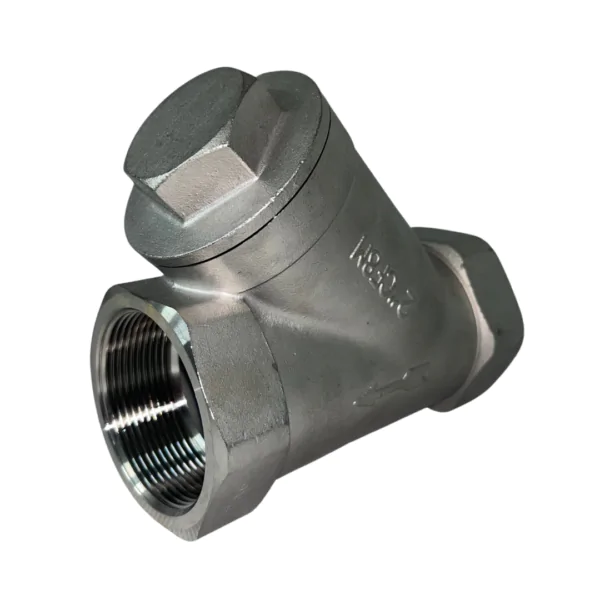
- Y‑Strainers
- Simplex and Duplex basket strainers
- Hygienic strainers for food & pharma
- Process filtration ancillaries
- Screens, meshes and service components
Browse our strainer range here:
Y‑Strainers

Ready to Improve Your Filtration Process?
Whether you’re designing a new system or upgrading existing equipment, BM Engineering provides expert technical support and high‑quality filtration solutions to meet your needs.
Connect With BM Engineering
LinkedIn: https://www.linkedin.com/company/bm-engineering-supplies
YouTube: https://www.youtube.com/channel/UC3546s0-sAomKMkm3QNJCVw
Facebook: https://www.facebook.com/BMEngineeringSuppliesLtd/photos/
FAQs
What types of filtration equipment does BM Engineering provide?
BM Engineering offers a range of filtration equipment including Y-strainers, simplex and duplex basket strainers, hygienic strainers for food and pharmaceutical industries, as well as screens, meshes, and other service components.
Why is filtration important in industries such as food, pharma, and manufacturing?
Filtration ensures product clarity, purity, and safety, helps protect critical equipment from damage, reduces downtime, supports regulatory compliance, and improves overall operational efficiency.
What are the main types of industrial filtration methods?
The main methods include mechanical filtration, which traps particles physically; chemical filtration, which removes dissolved contaminants through adsorption or ion exchange; and biological filtration, which uses microorganisms to break down organic materials, mainly in wastewater treatment.
How does mechanical filtration work in industrial processes?
Mechanical filtration physically traps particles using mesh, perforated screens, or cartridges, serving as the most common method for removing particulates from liquids or gases.
What is filtration and how is it used in industrial applications?
Filtration is the process of removing unwanted particles, solids, or contaminants from liquids or gases by passing them through a barrier called a filter medium, enhancing product quality and protecting equipment in various industries.